


Every driver encounters countless road signs daily, but do you truly understand what each one means? DMV road signs and meanings are critical tools that guide, warn, and protect everyone on the road.
Whether you’re navigating highway signs explanation or interpreting international road sign symbols, understanding these traffic control devices empowers you to make split-second decisions that could save lives. This comprehensive guide will unlock the secrets behind every sign you see.
Understanding the Importance of DMV Road Signs

Road sign meanings form the foundation of safe driving and effective traffic regulation. Every sign you encounter serves a specific purpose, whether it’s controlling traffic flow, warning about hazards, or providing navigation assistance. Understanding DMV road signs transforms confusing symbols into clear messages that guide your decisions and keep you safe on every journey.
These traffic control devices aren’t just suggestions, they’re essential communication tools between the road infrastructure and drivers. When you recognize a stop sign or understand speed limit enforcement, you’re participating in a system designed to protect everyone. Learning traffic signs and symbols builds the driver awareness necessary for defensive driving habits and helps you anticipate potential dangers before they become emergencies.
Read Also This: https://celebsname.com/fantasy-male-names/
Regulatory Signs: Rules You Must Follow
Regulatory signs communicate traffic laws and regulations that drivers must obey without exception. These signs include the stop sign, yield sign, speed limit sign, and no-entry warnings that form the backbone of legal compliance on roads.
The stop sign requires complete halting at intersections, ensuring proper right-of-way and preventing collisions. Speed limit signs indicate maximum safe speeds based on road conditions and traffic patterns. Yield signs instruct drivers to slow down and give priority to other vehicles or pedestrians. Each sign enforces specific rules that maintain order and safety.
| Common Regulatory Signs | Meaning | Action Required |
| Stop Sign | Complete halt required | Stop completely, check traffic, proceed when safe |
| Yield Sign | Give right-of-way | Slow down, yield to traffic, proceed with caution |
| Speed Limit | Maximum legal speed | Maintain speed at or below posted limit |
| No Entry | Road closed to traffic | Do not enter, find alternate route |
| One Way | Traffic flows one direction | Travel only in indicated direction |
Warning Signs: What They Alert You About

Warning road signs provide advance notice of potential hazards and changing road conditions ahead. These signs include sharp curve sign, pedestrian crossing, animal crossing, merge lane sign, and other critical alerts that help drivers prepare for unexpected situations. Recognizing these warnings is essential for hazard identification on roads and practicing defensive driving.
A sharp curve sign alerts you to reduce speed before navigating a dangerous turn, while a pedestrian crossing sign signals areas where people frequently cross streets. Animal crossing signs warn of wildlife in rural areas, and merge lane signs help maintain smooth traffic flow. Each warning provides crucial seconds to adjust speed and position.
Warning signs enhance accident prevention by giving drivers time to react appropriately. Understanding these signs develops anticipation skills and reinforces safe driving practices. Whether you’re a new driver or experienced motorist, respecting warning road signs protects everyone sharing the road and demonstrates responsible driving behavior.
Guide Signs: Directions and Information Explained
Guide and informational signs provide essential road navigation guidance that helps drivers reach their destinations efficiently. These signs include route markers, highway exit sign indicators, distance markers, and destination information that eliminate confusion and reduce stress. Understanding these signs improves road navigation guidance and prevents last-minute dangerous maneuvers.
A route marker identifies the highway number you’re traveling on, while exit signs clearly indicate where to leave the main road. Distance indicators show how far you are from cities or landmarks, making trip planning easier. Service signs direct drivers to rest areas, gas stations, and food options along the route.
Key Guide Sign Categories:
- Route markers – Identify highway numbers and directions
- Exit signs – Show upcoming exits and destinations
- Distance signs – Indicate miles to cities or landmarks
- Service signs – Direct to gas, food, and lodging
- Recreational signs – Point to parks and attractions
School Zone Signs: Keeping Students Safe
School zone signs are critical traffic control devices designed specifically for child safety near schools. These signs include reduced speed limit signs, school crossing warnings, and flashing lights that alert drivers to slow down during peak arrival and dismissal times. Understanding school zone safety demonstrates responsibility and protects vulnerable young pedestrians.
A school crossing sign warns that children may cross unexpectedly, while reduced speed limits ensure vehicles move slowly enough to stop quickly. Flashing lights emphasize critical hours when extra caution is needed. These signs create pedestrian and cyclist safety zones that prioritize children’s wellbeing over traffic speed.
Respecting school zone signs contributes to community safety and prevents tragic accidents. For new drivers, recognizing these signs early builds lifelong habits of attentiveness and patience. Experienced drivers reinforce their commitment to safe driving practices by slowing down and staying alert whenever these signs appear.
Construction and Work Zone Signs You Should Know
Construction zone traffic signs protect both drivers and workers in areas where road work is underway. These temporary traffic control devices include detour signs, lane closure warnings, flagger ahead notices, and reduced speed limits that guide traffic safely through work areas. Understanding construction and work zone signs is essential for work zone awareness and preventing accidents.
A detour sign directs traffic to alternate routes, preventing congestion and confusion during road repairs. Lane closure signs warn that a lane will end soon, giving drivers time to merge safely. Flagger ahead signs indicate workers controlling traffic, requiring drivers to slow down and follow instructions carefully.
Construction zone conditions change frequently, making driver awareness especially important. Reduced speed limits protect both motorists and construction crews from collisions. By respecting these temporary traffic control signs, drivers ensure smooth traffic flow and contribute to a safer environment for everyone working and traveling through these areas.
Railroad Crossing Signs: Safety Tips and Meanings
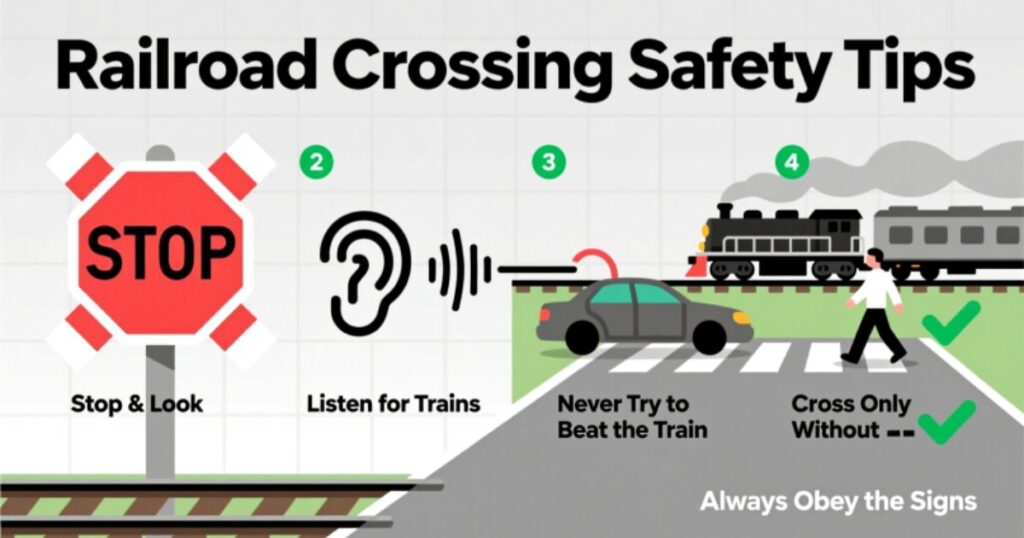
Railroad crossing signs are among the most critical traffic control devices on roads, designed to prevent devastating accidents where roads intersect with train tracks. These signs include crossbuck markers, flashing red lights, gate signals, and advance warning indicators that alert drivers early enough to stop safely before tracks.
A crossbuck sign marks the presence of train tracks and reminds drivers to yield to approaching trains. Flashing red lights and descending gate signals indicate an imminent train crossing, requiring complete stops until safe to proceed. Advance warning signs, typically circular with an “X” and “RR,” give drivers time to reduce speed.
Railroad crossing safety requires absolute compliance because trains cannot stop quickly. Understanding these traffic signs and symbols prevents catastrophic collisions and protects lives. By recognizing different signs and signals, drivers can anticipate danger, remain patient, and ensure safety for themselves, passengers, and nearby pedestrians during every crossing.
Parking Signs: Rules, Restrictions, and Fines
Parking signs establish clear parking regulations that maintain order and safety on streets and in public areas. These signs include no parking zones, restricted parking areas, handicapped parking spaces, and time-limited parking indicators that prevent congestion and ensure fair access. Understanding parking regulations helps drivers avoid fines, towing, and accessibility violations.
No parking signs indicate areas where stopping or leaving vehicles is prohibited, often near fire hydrants, intersections, or emergency zones. Time-limited parking signs specify duration limits for staying in one spot, encouraging turnover in busy areas. Handicapped parking signs reserve spaces for vehicles displaying proper permits, supporting accessibility.
Parking Sign Types and Meanings:
| Sign Type | Purpose | Penalty for Violation |
| No Parking Anytime | Prohibits all parking | Fine and towing |
| Time-Limited Parking | Restricts duration | Fine after time expires |
| Handicapped Parking | Reserved for permit holders | Heavy fine and towing |
| No Stopping Zone | No stopping for any reason | Fine and possible towing |
| Street Cleaning | Temporary restrictions | Fine and towing on scheduled days |
International Symbols on DMV Road Signs
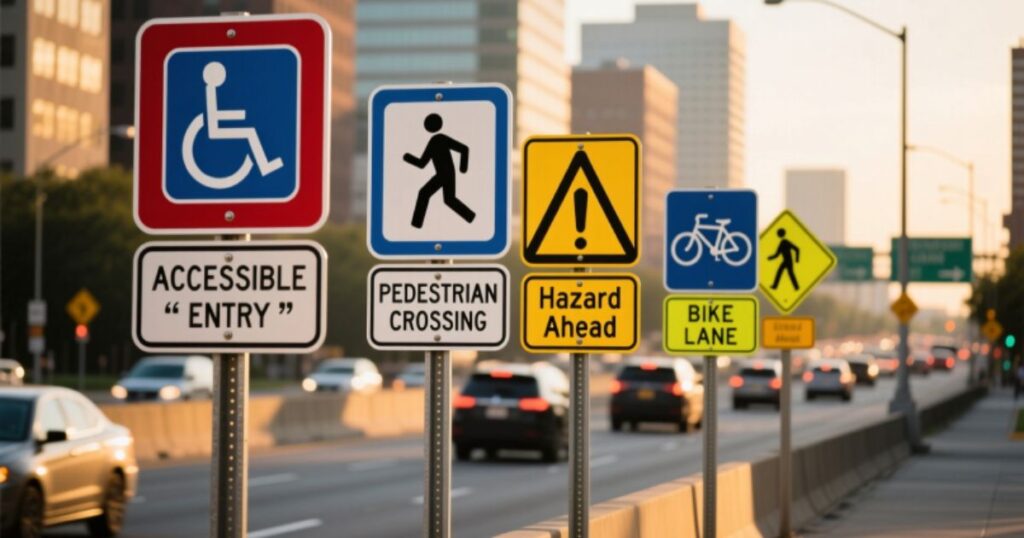
International road sign symbols use universal icons that transcend language barriers, ensuring drivers from any country can understand critical information. These international symbols include pedestrian icons, bicycle lane markers, curve arrows, and highway exit symbols that communicate clearly without words. Understanding these symbols enhances road navigation guidance for everyone, including tourists and international drivers.
A pedestrian icon clearly signals crossing areas, while bicycle symbols indicate designated cyclist safety lanes. Curved arrow signs show upcoming turns, and highway exit symbols guide drivers toward correct routes. These traffic signs and symbols standardize safety messages across states and countries, reducing confusion significantly.
Learning international road sign symbols prepares drivers for travel in unfamiliar areas and improves overall driver awareness. The use of universal icons makes road sign interpretation faster and more intuitive, allowing quick recognition and appropriate responses. By mastering these symbols, drivers navigate confidently and ensure safety for themselves and everyone around them.
How Knowing DMV Road Signs Can Save Lives
Understanding road sign meanings extends far beyond passing tests, it directly impacts accident prevention and pedestrian and cyclist safety. DMV road signs provide the critical guidance drivers need to make safe split-second decisions, from slowing in school zones to stopping at intersections. Each sign communicates information that helps prevent collisions and protects lives on every road.
Recognizing a warning sign before a sharp curve allows timely speed reduction, while observing a stop sign ensures safety for other vehicles and pedestrians. Even simple signs like yield or pedestrian crossing play enormous roles in avoiding accidents. Knowledge transforms everyday driving into safer, more predictable experiences.
By mastering DMV road signs and meanings, drivers develop enhanced driver awareness, defensive driving habits, and the ability to anticipate potential hazards effectively. This knowledge protects not just the driver but also passengers, pedestrians, and fellow motorists. Every sign serves a purpose, and respecting them demonstrates responsibility and care for everyone’s safety.
DMV Road Signs and Meanings
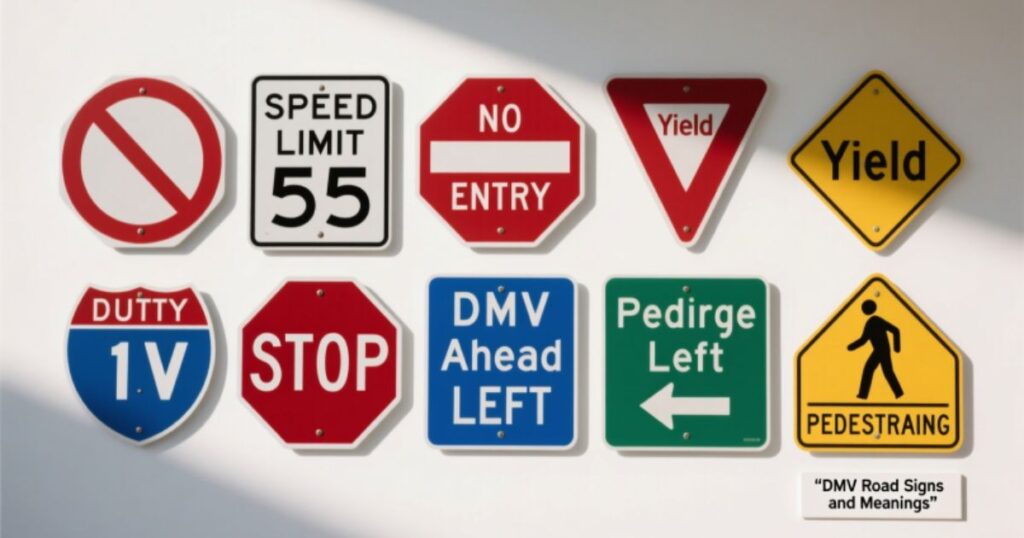
DMV road signs and meanings encompass the complete system of traffic signs and symbols used to regulate, warn, and guide drivers on all roads. Understanding this comprehensive system is fundamental to legal compliance, safe driving practices, and successful DMV test preparation. These signs form a visual language that communicates essential information instantly and effectively.
The system includes regulatory traffic signs that enforce laws, warning road signs that alert to hazards, and guide and informational signs that provide directions. Each category serves distinct purposes but works together to create a coordinated safety network. Mastering road sign meanings helps drivers interpret any sign they encounter confidently.
Learning DMV road signs and meanings benefits both new and experienced drivers by reinforcing understanding of traffic laws and regulations. This knowledge supports better hazard awareness, smoother navigation, and more confident driving in all conditions. Whether preparing for tests or improving skills, understanding these signs is essential for every driver.
20 Road Signs and Their Meaning
Understanding the most common 20 road signs and their meaning provides a solid foundation for safe driving and DMV test preparation. These essential signs represent the core traffic control devices every driver encounters regularly. Memorizing these signs and their meanings enhances driver awareness and supports defensive driving on all roads.
Essential Road Signs Every Driver Should Know:
- Stop Sign – Octagonal red sign requiring complete halt
- Yield Sign – Triangular sign indicating give right-of-way
- Speed Limit Sign – White rectangular sign showing maximum speed
- No Entry Sign – Red circle with white bar prohibiting entry
- One Way Sign – Rectangular sign showing traffic direction
- Pedestrian Crossing – Yellow diamond with walking figure
- School Zone Sign – Fluorescent yellow-green with children symbols
- Railroad Crossing – Round yellow sign with “X” and “RR”
- Merge Sign – Yellow diamond showing converging lanes
- Sharp Curve Sign – Yellow diamond with curved arrow
- Slippery When Wet – Yellow diamond with skidding car
- Road Work Ahead – Orange diamond warning of construction
- Detour Sign – Orange with directional arrow
- No Parking Sign – Red and white indicating parking prohibition
- Handicapped Parking – Blue sign with wheelchair symbol
- Exit Sign – Green rectangular sign showing highway exit
- Route Marker – Shield-shaped sign identifying highway number
- Divided Highway – Yellow diamond showing divided road ahead
- Flagger Ahead – Orange diamond warning of traffic control person
- Animal Crossing – Yellow diamond with animal silhouette
All Road Signs
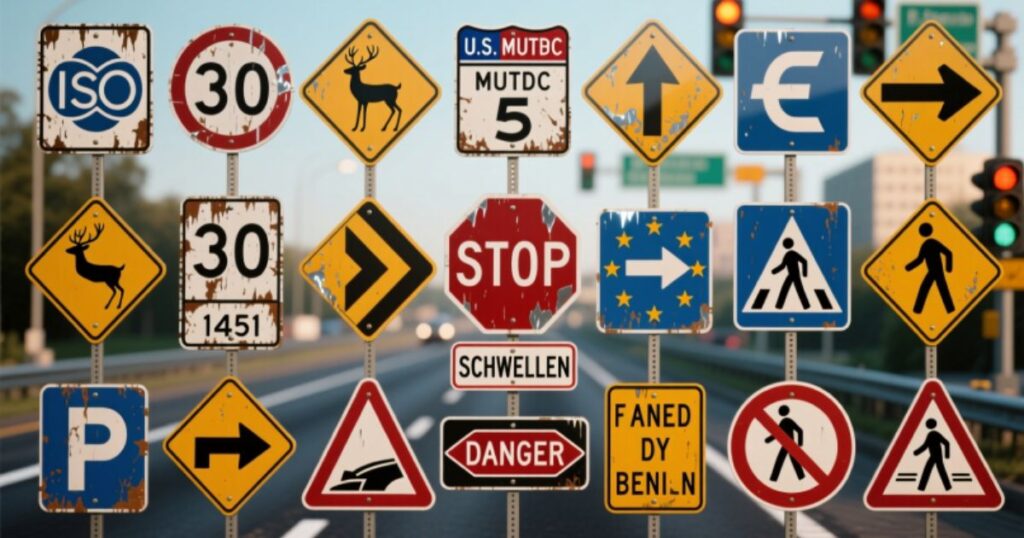
All road signs collectively form a comprehensive visual communication system that guides safe driving practices nationwide. This complete system includes regulatory signs, warning signs, guide signs, construction signs, railroad signs, parking signs, and international symbols. Understanding all road signs ensures drivers can navigate any situation safely and legally, regardless of location or conditions.
The system is designed with standardized shapes, colors, and symbols to ensure instant recognition and understanding. Red typically indicates prohibition or stop, yellow warns of hazards, green provides guidance, orange marks construction zones, and blue shows services or information. Each color and shape combination conveys specific meaning.
Road Sign Categories and Purposes:
- Regulatory Signs – Enforce traffic laws and regulations
- Warning Signs – Alert to potential hazards ahead
- Guide Signs – Provide navigation and route information
- Construction Signs – Indicate work zones and detours
- School Signs – Protect students near educational facilities
- Railroad Signs – Warn of train crossings
- Parking Signs – Control parking and stopping
- Service Signs – Direct to amenities and facilities
Road Signs Test
A road signs test evaluates your knowledge of traffic signs and symbols, ensuring you understand DMV road signs and meanings before earning driving privileges. This essential component of DMV test preparation assesses your ability to recognize and interpret regulatory traffic signs, warning road signs, and guide and informational signs accurately. Passing requires thorough study of road sign meanings.
The test typically includes multiple-choice questions showing various signs and asking you to identify their meanings or appropriate driver responses. Questions cover stop signs, yield signs, speed limit signs, pedestrian crossings, railroad crossings, and construction zone warnings. Understanding sign shapes, colors, and symbols is crucial for success.
Tips for Passing Your Road Signs Test:
- Study all road signs systematically by category
- Learn color and shape meanings for quick recognition
- Practice with online quizzes and sample tests
- Understand the logic behind each sign’s design
- Focus on commonly confused signs like yield versus merge
- Review international symbols and their meanings
- Test yourself regularly until recognition becomes automatic
Easy Way to Remember Road Signs

An easy way to remember road signs involves using memory techniques, pattern recognition, and logical associations that make road sign interpretation intuitive. Instead of memorizing randomly, organize signs by shape, color, and function to create mental frameworks. Understanding the logic behind sign design makes recognition automatic and supports better driver awareness and safe driving practices.
Shapes provide instant clues: octagons always mean stop, triangles indicate yield, circles warn of railroad crossings, diamonds signal warnings or hazards, and rectangles provide regulations or guidance. Colors also convey meaning: red prohibits or warns, yellow cautions, green guides, orange indicates construction, and blue shows services.
Memory Strategies for Road Signs:
- Shape Association – Octagon = Stop, Triangle = Yield, Circle = Railroad
- Color Coding – Red = Stop/Prohibit, Yellow = Warning, Green = Go/Guide
- Function Groups – Group regulatory, warning, and guide signs together
- Visual Stories – Create mental scenarios for each sign’s purpose
- Repetition Practice – Review signs daily until recognition is instant
- Real-World Application – Identify signs while driving or riding as passenger
- Flashcard Method – Create cards with signs and quiz yourself regularly
Show Me Road Signs
When someone says “show me road signs,” they’re seeking visual examples and explanations of traffic signs and symbols used on roads. Visual learning is highly effective for understanding DMV road signs and meanings because it mimics real-world driving conditions. Seeing actual signs helps drivers recognize them instantly when encountered on streets and highways.
Visual references should include clear images of each sign along with its shape, color, and meaning. Understanding what each sign looks like in real conditions, not just in books, prepares drivers for actual road navigation guidance. Photos, diagrams, and illustrations all support better retention and recognition skills.
Common Road Signs Visual Reference:
| Sign Image | Name | Shape | Color | Meaning |
| Octagon | Stop Sign | 8-sided | Red/White | Complete stop required |
| Triangle Point Down | Yield Sign | Triangle | Red/White | Give right-of-way |
| Rectangle | Speed Limit | Rectangle | White/Black | Maximum speed allowed |
| Diamond | Warning | Diamond | Yellow/Black | Hazard ahead |
| Circle | Railroad | Circle | Yellow/Black | Train crossing ahead |
How to Read Traffic Signs
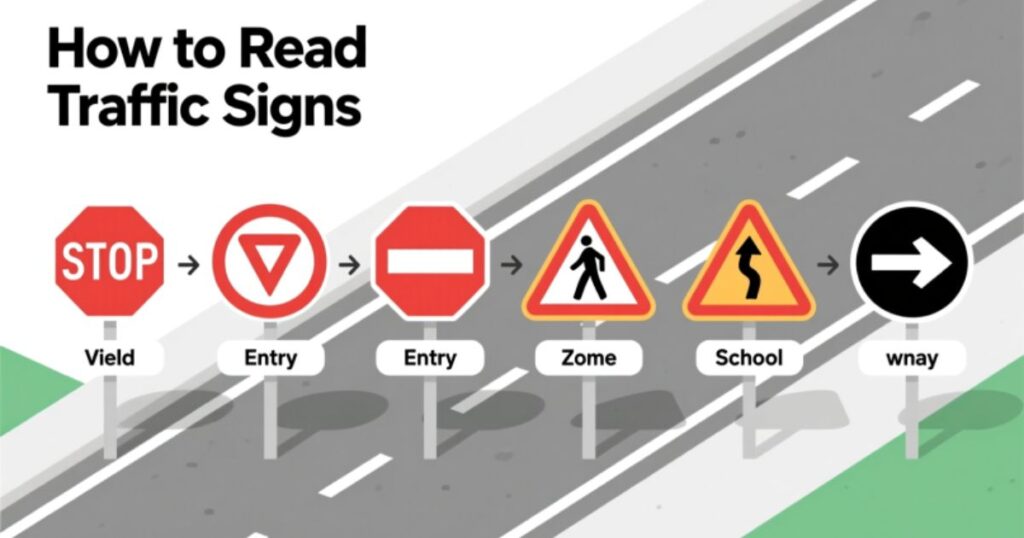
Learning how to read traffic signs involves understanding the standardized system of shapes, colors, symbols, and text that communicate traffic laws and regulations. Traffic control devices use visual language designed for instant recognition and comprehension, even at high speeds. Mastering this visual language is essential for safe driving practices and effective hazard identification on roads.
Start by recognizing that sign shape indicates the type of message: regulatory, warning, or guidance. Color adds meaning, red for stop or prohibition, yellow for caution, green for direction, orange for construction, and blue for services. Symbols and text provide specific details about the message being communicated.
Steps to Read Traffic Signs Effectively:
- Identify the shape – Determines sign category (regulatory, warning, guide)
- Note the color – Adds context (prohibition, caution, information)
- Read the symbol – Provides specific meaning (pedestrian, curve, merge)
- Check any text – Gives detailed instructions or measurements
- Consider context – Location and surrounding conditions add meaning
- React appropriately – Adjust speed, position, or route based on sign
15 Road Signs and Their Meanings
Understanding 15 road signs and their meanings gives drivers essential knowledge of the most frequently encountered traffic signs and symbols. These core signs represent fundamental driving safety rules and traffic regulation principles that every driver must know. Mastering these signs supports successful DMV test preparation and confident, safe driving in all conditions and locations.
15 Essential Road Signs:
- Stop Sign – Red octagon requiring complete halt at intersections
- Yield Sign – Red/white triangle indicating give right-of-way to others
- Speed Limit – White rectangle showing maximum legal driving speed
- No Entry – Red circle with white bar prohibiting entry
- One Way – White rectangle with black arrow showing traffic direction
- Do Not Enter – Red circle with white horizontal bar
- School Zone – Fluorescent yellow-green warning of children present
- Pedestrian Crossing – Yellow diamond with walking person symbol
- Railroad Crossing – Yellow circle with black “X” and “RR” letters
- Merge – Yellow diamond showing lanes converging ahead
- Sharp Curve – Yellow diamond with curved arrow indicating turn
- Slippery When Wet – Yellow diamond with skidding car icon
- Construction Ahead – Orange diamond warning of road work
- No Parking – Red and white sign prohibiting parking
- Exit Sign – Green rectangle showing highway exit information
Read Also This: https://celebsname.com/ptso-meaning-slang/
Frequently Asked Questions
What do common DMV road signs mean?
They provide instructions for safe driving. Each color and shape signals a specific type of rule or warning.
How can I quickly understand confusing road signs?
Look for shapes and colors first. They tell you whether the sign is regulatory, warning, or informational.
What do yellow diamond-shaped signs tell drivers?
They warn of upcoming hazards or changes in the roadway. Drivers should prepare to slow down or adjust course.
Why are some DMV signs red while others are green or blue?
Red indicates prohibitions or required stops. Green and blue give directions or service information.
How do I remember the meaning of rare or unusual DMV signs?
Study them by category and shape. Repetition and practice tests help the meanings stick.
What does a regulatory DMV sign tell drivers?
It communicates rules that must be followed. These include speed limits, lane use, and turn restrictions.
How can I tell if a road sign is giving me a warning?
Warning signs are usually yellow with black symbols. They alert you to conditions that may require caution.
What do guide signs on the highway mean?
They provide directions, distances, and route information. Their green color helps drivers navigate easily.
How do construction zone signs differ from regular road signs?
They’re typically orange to signal temporary changes. Drivers should slow down and stay alert in these areas.
What does a blue DMV sign indicate?
It points to services like rest areas, hospitals, or fuel. These signs help travelers find essential amenities.
Conclusion
Mastering DMV road signs and meanings is an essential skill that goes far beyond test preparation, it’s a lifelong commitment to safety, responsibility, and confidence on the road. From regulatory traffic signs that enforce laws to warning road signs that prevent accidents, each sign serves a critical purpose in protecting lives.
Your commitment to understanding these traffic control devices demonstrates respect for traffic laws and regulations and genuine care for everyone sharing the road. By mastering these signs, you’re not just passing a test, you’re embracing a responsibility that protects lives, prevents accidents, and contributes to safer communities for everyone.

Hi, I’m Dome — the face behind CelebsName, your daily source for real celebrity facts, names, and stories.